




HAMADĀN
Hamadān is one of the western provinces of Persia, situated to the southwest of Tehran between latitudes 33°59’ and 35°48’ north and longitudes 47°34’ and 49°36’ east. The city of Hamadān (the capital of the province) is located at 37°47’ N and 48°30’ E, at an altitude of 1,645 m on the eastern slope of the Alvand massif (q.v.; alt. 3,571 m; the Mount Orontes of the Classical sources). In the National Physical Plan (Ṭarḥ-e kālbodi-e melli), which divides the country into 10 regions, it is identified as a part of the central Zagros sub-region (Moʾassasa-ye ʿāli-e pažuheš, p. 1). The province of Hamadān is bounded, clockwise, by the provinces of Zanjān and Qazvin to the north, the Markazi (Central) Province to the east, the province of Lorestān to the south, and the provinces of Kermānšāh and Kordestān to the west. According to the last national census (1996), Hamadān Province covers an area of 19,493 km2, constituting about 1.2 percent of the country’s total area, with a population of 1,672,957 (Markaz-e āmār-e Irān).
According to the national census of 1956, the present province of Hamadān used to be part of the province of Kermānšāhān, which was composed of the governorships (farmān-dāri) of Hamadān, Tuyserkān, Malāyer, and Nehāvand. The governorship of Hamadān had a total population of 695,283, of which 178,949 lived in eight cities (Zanjāni and Raḥmāni, p. 23). It was upgraded to the general governorship (farmān-dāri-e koll) of Hama-dān in 1966, but in the following censuses it was promoted to the province (ostān) of Hamadān and its area underwent minor modifications: 20,172 km2 in 1966 and 1976, 19,445 km2 in 1986, and 19,493 km2 in 1996 (Zanjāni and Raḥmāni, p. 6).
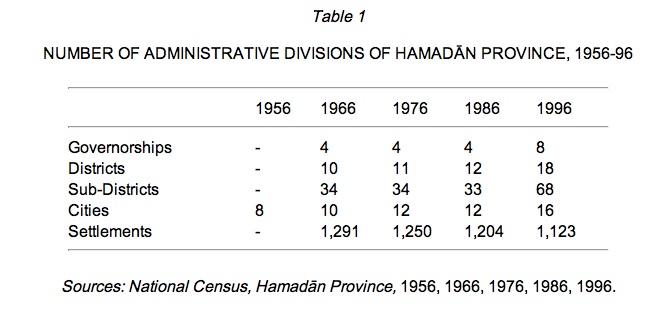
The internal division of this province within its present boundaries is shown in Table 1 (Zanjāni et al., p. 7).
Mountains. Hamadān is a mountainous region, located on the eastern flanks of the Zagros range, which stretches from the northwest to the southeast of Persia. The highest point, Alvand Kuh (q.v.), reaches an altitude of 3,580 m above sea level. A mass of granite and diorite, Alvand Kuh extends across the southern and eastern parts of the city of Hamadān and is its most prominent landmark. There are at least 12 other peaks in the Alvand range of more than 3000 m altitude. The lowest point of the province, where the river Gāmāsiāb flows out of the governorship of Nahāvand, descends to the altitude of 1,420 m (Jaʿfari, pp. 77-79; Faraji, p. 1290; Fāṭemi, p. 2). An interesting feature of the Hamadān–Kermānšāh area as far as the Bušehr region is that “the folds are extremely regular, straight in form and parallel in strike, and relatively packed together” (Fisher, p. 17).
Table 2 illustrates the relative importance of various products in 1998.

Orchards account for about 6.1 percent of cultivable land. Annually about 2.2 to 2.6 million tons of agricultural products are produced in Hamadān, which is about 4.8 percent of the produce of the country as a whole (Fāṭemi, p. 124).
Industry. Hamadān has been known for its handicraft industry, including tanning (see DABBĀGĪ), carpet-weaving, ceramics (qq.v.), and knitting for a long time, and in 1998 some 1,443 production units were active in this field. Hamadān’s contemporary industrial activity extends from light to heavy industry, including the production of food (dairy products, canned fruits, sugar, soft drinks), textiles, plastics, household goods, mining, construction and metallurgy. During the period 1994-98, a total of 453 industrial operation permits were issued. In 1995, there were 266 large industrial units in operation in Hamadān, employing 8,620 people (Markaz-e āmār-e Irān, pp. 188, 191-92). Large units producing agricultural and construction machinery, aluminum products, and steel are already operational or under construction.
Hamadān is fairly rich in minerals, including granite (the most important source of it in the country) and ornamental stones, limestone, silica, lead, zinc, and iron ore. In 1998, there were 142 active mines in Hamadān, including 52 sandstone, 36 silica, 19 ballas, 13 ornamental stones, and 14 limestone mines, employing 819 persons (Markaz-e āmār-e Irān, pp. 198-99).
There are 2,034 km of inter-city roads in Hamadān, of which 236 km are highways and 492 km are main roads; the rest are secondary roads. There are also 3,068 km of rural roads of which 2,507 are macadam (Markaz-e āmār-e Irān, pp. 227-28).
Languages spoken. Hamadān has been a crossroads of civilizations for millennia and a mosaic of cultures and dialects live there side by side. The main language spoken, especially in the provincial capital and its surroundings, is Persian, which is also the lingua franca in other regions. In the northern parts of the province, however, the language mostly spoken is Azeri Turkish, while in the northwest and west, near the provinces of Kurdistan and Kermānšāhān, people mostly speak Kurdish, while in some other cities such as Malāyer, Nehāvand, and Sāmen most people speak Lori and Lak (Faraji, p. 1296).
Bibliography
Rabiʿ Badiʿi, Joḡrāfiā-ye mofaṣṣal-e Irān, 3 vols., Tehran, 1988.
Dāyera-ye joḡrāfiāʾi-e Setād-e arteš, Rāhnemā-ye šahr-e Hamadān, Tehran, 1952.
Moḥammad Borhāni and Āryā Partovi Deylami, Gozāreš-e moṭālaʿāt-eābhā-ye zir-e zamini-e Hamadān, Tehran, 1982.
Hélène Desmet-Grégoire, “Le pain dans le région d’Hamadān (Iran),” Stud. Ir. 9/2, 1980, pp. 251-76.
Idem and Patrice Fontaine, La region d’Arak et de Hamadan: cartes etdocuments ethnographiques, Stud. Ir., Cahier 6, Leuven, 1988.
Eckart Ehlers, “Der Alvand Kuh: Zur Kulturgeographie eines iranischen Hochgebirges und seines Vorlandes,” in Adolf Leidlmair-Festschrift, Insbrucher Geographische Studien 5, 1979, pp. 483-500.
Idem, Iran: Grundzüge einer geographischen Landeskunde, Darmstadt, 1980, pp. 61-62, 91-92, 293-94, 379-81.
Ebrāhim Eṣlāḥ ʿArabāni, ed., Rāhnemā-ye šahrestānhā-yeIrān, Tehran, 1966, pp. 518-26.
ʿAbd-al-Reżā Faraji, ed., Joḡrāfiā-ye kāmel-e Irān, Tehran, 1987.
Sayyed Abu’l-Ḥasan Fāṭemi, Simā-ye gardeš-gari-e ostān-e Hamadān, Hamadān, 2001.
W. B. Fisher, “Physical Geography,” in Camb. Hist. Iran I, pp. 3-110.
Gazetteer ofIran I, pp. 176, 219-23, 430, 486, 668.
ʿAbd-al-Rafiʿ Ḥaqiqat “Rafiʿ,” Farhang-e tāriḵi o joḡrāfiāʾi-e šahrestānhā-ye Irān, Tehran, 1996, pp. 641-44.
Kano Hiromasa, “City Development and Occupational Change in Iran: A Case Study of Hamadan,” The Developing Economies 16/3, Tokyo, pp. 298-328.
A. V. Williams Jackson, Persia Past and Present, New York and London, 1906, pp. 146-50.
ʿAbbās Jaʿfari, Gitā-šenāsi-eIrān I: kuhhā wa kuh-nāma-ye Irān, Tehran, 1989.
Idem, Gitā-šenāsi-e Irān II: rudahā wa rud-nāma-ye Irān, Tehran, 1997.
Masʿud Keyhān, Joḡrāfiā-ye mofaṣṣal-e Irān, 3 vols., Tehran, 1932, I, pp. 59-60; II, pp. 379-86.
Markaz-e āmār-e Irān, Šenās-nāma-ye āmāri-e šahrhā-ye ostān-e Hamadān, Tehran, 1996.
Idem, Āmār-nāma-ye ostān-eHamadān, sāl-e 1377, Tehran, 1999.
Moʾassesa-ye ʿāli-e pažuheš dar barnāma-rizi wa tawseʿa, Ṭarḥ-e moṭāleʿāt-e jāmeʿ-e tawseʿa-ye Ostān-e Hama-dān, Section 2: Omur-e ejtemāʿi, Tehran, 2002.
Xavier de Planhol, “Geography of Settlement,” in Camb. Hist. Iran I, pp. 409-67.
Ḡolām-Ḥosayn Qarāguzlu, Hagmatāna tā Hamadān, Tehran, n.d., pp. 19-23, 93-126, 515 ff.
Razmārā, Farhang V, pp. 353, 432-35, 460-62, 479-86, 512-17.
P. Schwartz and A. Miquel, “Karkha,” in EI2 IV, pp. 653-54.
Ḥabib-Allāh Zanjāni et al., Sawābeq-e jamʿiati-e šahrhā wa ābādihā-ye Ostān-e Hamadān, publication nos. 2-4, in Ṭarḥ-e kālbodi-e melli, Markaz-e moṭāleʿāt wa taḥqiqāt-e šahr-sāzi wa meʿmāri-e Iran, Tehran, 1992, p. 7.
Ḥabib-Allāh Zanjāni and Faridun Raḥmāni, Rāhnemā-ye jamʿiat-e šahrhā-ye Irān 1335-1370, Tehran, 1989.